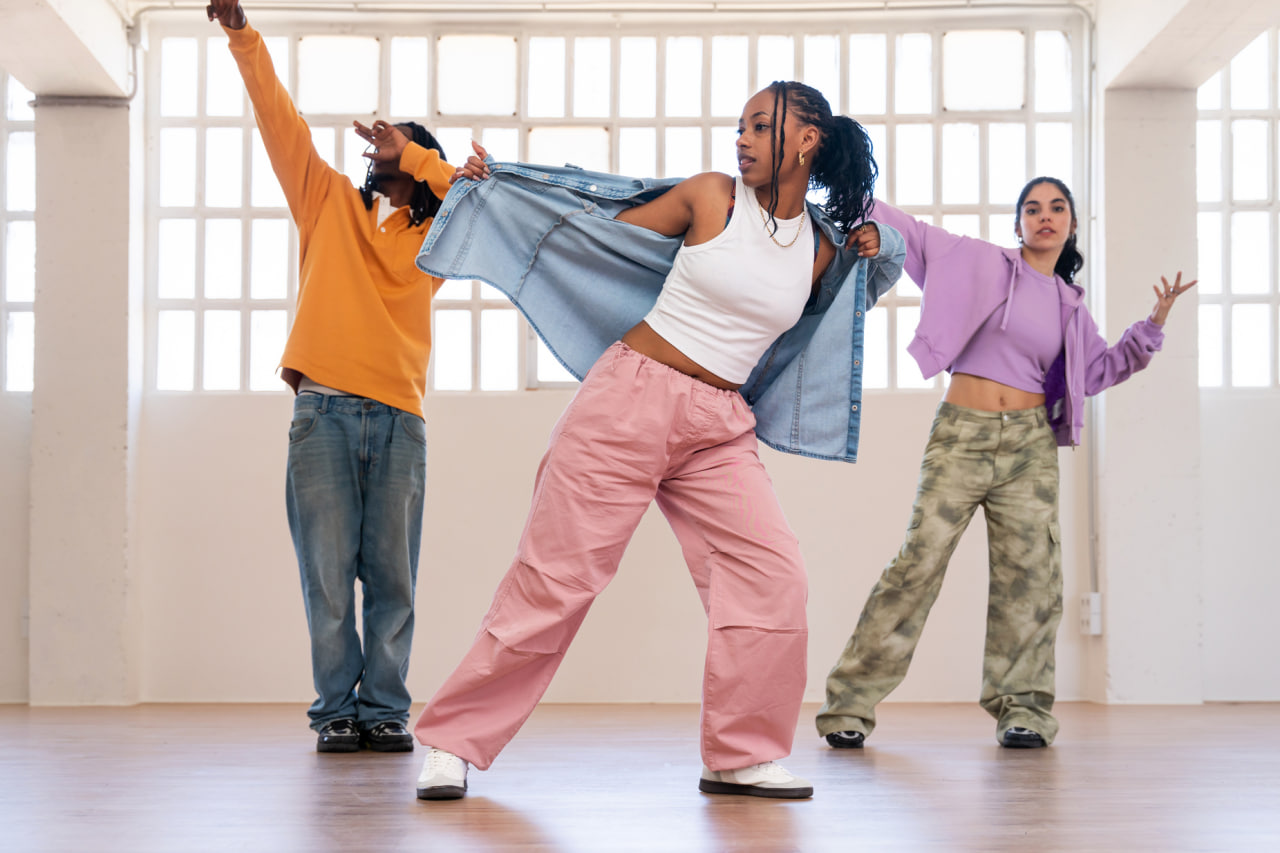
The Fundamentals of Choreography
Movement vocabulary is what a dancer has in their tool box to draw upon and connect in order to choreograph. To use a writing analogy, if an author doesn’t have a large vocabulary, their sentences will either be very short, or they will repeat the same word over and over again. Similarly, if a choreographer has a limited movement vocabulary, their phrases will be awkwardly short, or will repeat the same movements over and over again. They may also rely heavily on movements that are not very technical.
Vocabulary is not a series of steps that one memorizes. Rather, it is the way the body navigates through space, the way it responds to rhythm, the way it can convey emotion or intention through movements. Having a vocabulary means that one can choreograph from an intentional place, rather than simply copying movements.
Technique plays a significant role in the process of learning vocabulary.
Technique provides the necessary foundation for freedom of movement. It involves proper alignment, balance, coordination, flexibility and strength, all of which allow you to perform movement safely and correctly. With good technique you do not have to worry about the technical aspects of movement because your body will already know how to accomplish the movement.
Practice in the basics (ballet for alignment and placement, contemporary for movement quality, hip hop for musicality and swag) enhances your range of motion. Each genre offers a different flavor and aesthetic. The broader your technical education, the broader your kinetic language.
But technique is not enough. It must be married to knowledge. Knowing why a step works, what happens with the weight, how the weight flows from one step into the next, makes the vocabulary flexible rather than absolute.
Musicality: Enhancing Your Musical Vocabulary
Music influences choreography. Good musicality helps with movement decisions and multiplies the potential choreographic possibilities. If students are able to understand and recognize beats, accents, changes in tempo and musical expression, it opens up a whole new dimension of expression.
Rather than dancing on the beat every time, they can play with syncopation, stillness, stretches or accents. They can react to nuances within the music, not just the beat. This approach shifts technique from steps into narrative language.
Furthermore, dancing choreography without music aids the development of inner rhythm as well. This is because it forces dancers to create their own timing, thereby giving them more ownership and freedom.
Space, Levels, and Direction
— Movement is not just what you’re doing, but where you’re doing it. Spatial relationships can add depth to the choreography. Varying levels can provide a lot of variety (floor work, suspensions, mid-range transitions, overhead movements).
Finally, direction is important. By altering directions, moving diagonally, going from one side of the stage to the other, or coming back in to the center of the stage, we add variety. The same step may look totally different depending on the direction and the path it takes.
Intentional work on space helps dancers prevent this and develop a language that looks multi-dimensional and interesting.
Motion Dynamics and Texture
Two dancers perform the same sequence of steps and achieve completely different effects. This is dynamics. More movement vocabulary is available when we consider changes in speed, force, tension, release, and flow.
Like sharp and smooth, or heavy and light, or sustained and percussive, these help to add variety to a dance and keep it interesting. Also, to practice these different qualities while doing the same combination helps to develop your ability to vary your dynamics.
Dynamic texture in motion can be used to express emotion. For example, weak and smooth movement can imply sensitivity while strong and weighty motion can express confidence. Therefore, having a larger dynamic repertoire makes the language more emotionally expressive.
The Power of Improv
Perhaps the greatest tool in building a movement vocabulary is improvisation. Improvisation offers dancers the space to explore freely, without any critical attachment, and may lead them to pathways or movements that they had never thought to use.
Specific improvisational directives like leading with just one part of the body, navigating circles, or responding to stillness will force your creativity out of its usual boxes. Eventually, all of these explorations will join your language of readily available tools.
Improvisation can develop your adaptability too. It helps to be able to react in the moment when you’re performing or when you’re working with other people.
“Repetition is the mother of learning, information, and habit; and all skills are obtained through practice.” -Tony Robbins.
Learning new words involves a lot of repetition. Repetition of the basics is necessary to hone accuracy and build muscle memory. But it’s best to approach repetition with intention, not on autopilot.
Refining is about finessing the timing, spatial relationships, and dynamics. It’s about looking at the transitions between moves and making sure they make sense. Repeating the moves with attention is what turns them into clear and defined movements that can be choreographed.
It is also helpful to make recordings of practice and analyze them. I find that I can notice things in recordings that I cannot notice while performing.
How Can We Learn From Other’s Experience Without Copying?
Taking choreography classes from various teachers and genres opens the mind. Observing concerts, attending master classes, and viewing videos of professional dancers help a dancer to see new ways and possibilities.
Don’t copy, but be inspired and transform: a dancer should look at the steps and try to understand what’s strong about it — is it the rhythm? Is it the pathway? Is it the juxtaposition of different energies? Take that, and then let it be translated into your own vocabulary.
There are a number of ways to develop your own personal movement signature. The first is to simply choose to dedicate some portion of your day to deliberate movement. This could mean waking up a little earlier and starting with 10 minutes of yoga or a brisk walk. You could take a longer lunch break and do a few laps around the office building, or pop in a workout video at home during your lunch hour. Perhaps you could commit to taking the stairs every time you enter a building, no matter what floor you need to go to, or make a pact with a coworker to do a set of jumping jacks every time you head to the water cooler together.
So, the more advanced you get, you know, the larger the movement vocabulary, the more likely you’ll find your individuality. Your style comes from the technical ability, from the musicality, from the creativity, and so on.
A choreographer’s signature doesn’t just emerge overnight. It will develop the more you work and the more you pay attention to your own patterns. This could mean maintaining a choreography journal to keep track of the kinds of moves that reappear, or it might mean pushing yourself to figure out really interesting transitions.
Being an individual doesn’t mean you’re doing something completely unique compared to others. It means that you’re making conscious and authentic decisions with your movement.
Applied Practice: Movement Vocabulary Building
Dancers can practice some basic methods on a daily basis to increase their choreography abilities:
Take one simple movement and modify it with five different levels.
Set an 8-count phrase that only involves the arms, and then go through it again with attention to the feet.
Now do a combination at three speeds.
Now improvise for 2 minutes and focus on playing with the melody instead of the rhythm.
Invert a sequence to learn how to change course.
These little difficulties help you slowly become more flexible and self-assured.
The key to success here is not to overcomplicate things, but rather to maintain a consistent effort.
Tricks are one of the most misused elements in dance and are often considered by dancers as the mark of “good choreography”. In fact, it’s not about how difficult your tricks are, it’s about how clear and purposeful they are. A basic step executed with sharpness and control can look way better than a really difficult one done sloppily.
Consistency = dependability. Training everyday, even for a few minutes keeps the muscles trained and the creative juices going. After awhile, the little gains add up.